
Social Clause proposal refers to the inclusion of specific provisions in the instruments of World Trade Organisation, which bestows on governments, the right to deny access to their markets for products from countries or units that violate predefined universal labour standards. It, therefore, intends to establish a tie between international trade and compliance with labour standards. The issue has generated intense debate at national and international levels, on the questions like the need and scope of universal labour standards, the effectiveness of monitoring labour standards by linking it up with international trade, the rationale for the proposal, acceptance or rejection, the emerging structure of world economy, the overwhelming influence of MNCs in global economy, the emerging international division of labour, the case for trans-border alliances, possibilities for non-trade linked labour standards etc. This issue of Labour File attempts to participate in this debate, while affirming a position evolved after dialogue among organised and informal sector trade unions and NGOs. .
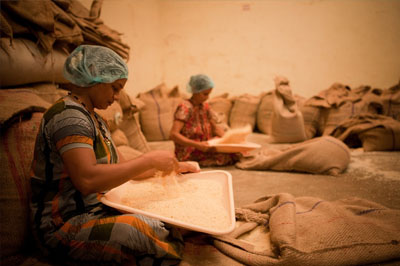 The positions and counter positions of governments, labour organisations and NGOs in the north, generally reflect two tendencies. First, a tendency to perceive developing countries, whose borders have been thrown open for global trade, as a threat to their very survival. Second, a penchant to articulate concerns for labour, in terms of the prevailing rights violations in developing countries and the plausibility for escalation in exploitation and repression at workplace on a global scale. Homogenisation of labour, standards is recommended, to create a level playing field, so that no one takes undue advantage of labour to achieve greater competitiveness in trade. The argument has caught the imagination of genuine humanist groups in the developed countries and organisations of extremely vulnerable sectors in the developing countries.
Probably, what is not so apparent is that the argument does not have sound moorings in the material reality of global economic structure and the emerging international division of labour. Consider the fact that 80% of world GNP is concentrated in the developed countries where world`s richest 20% live. The poorest 20% of the world population has only a share of 1.4% of world GNP. While over 80% of European community`s overseas investment goes to other members of OECD, only less than 10% goes to the newly industrialised Asian and Latin American countries. Multinationals now control a third of productive assets in the private sector. Uruguay Round of GATT negotiations has only strengthened the unequal and unjust world economic order. Monitoring labour standards bound with unequal trading system will beget only unjust and distorted results.
In the lead article in this issue of Labour File, Ashim Roy points out that the international debate on social clause serves an ideological function – to create wedge between the workers of developed and developing countries. In the debate, self interest and nationalism are articulated as key factors that motivativate the self and reject the other.
The report also brings into focus the inadequacy of outright rejection, which tends to assume nationalist overtones. Most often, such positions are indistinguishable from that of the government`s and the employer`s. In any case, it is inhuman to argue for the comparative advantage accruing from low wages and denial of labour rights. The working group report calls for building up wider labour alliances towards genuine globalisation, for effective mechanisms and strategies for protecting labour rights at the national level and for the evolution of non-trade linked monitoring of labour rights.
The action plan proposed by the consultation that deliberated on the above report, included suggestions for a UN Convention on Labour Rights as an alternative to the social clause proposal, and for creating mechanisms for monitoring labour rights within the country. The statement from the consultation is incorporated in this issue.
The exclusive interviews with labour leaders from Pakistan and Bangladesh were included to introduce a South Asian perspective. They, along with leaders from other countries in the region, have decided to convene a consultation to draft a South Asian Charter on Labour Rights. Anuradha Chenoy`s report is on an international meeting held in Italy to discuss the dignity of labour. Labour File will consistently be pursuing these debates and follow up actions at the national, regional and international levels.
Unorganised/informal sectors are at the heart of Labour File`s concerns. We acknowledge the significance of the formation of National Centre for Labour (NCL). In the report on NCL, we cover their list of demands, and their reaction to government`s refusal to allow participation of unorganised and informal sector Trade Unions in the recently held Indian labour conference.
Labour File, Vol.A1-No.2, Labour Rights in MTA (Editorial – Labour Rights in MTA – pp 1 – 2)